Diffusion multi-material#
The first MMS problem has two materials (denoted, respectively, by left and right). In material left, the solubility is \(K_{S,\mathrm{left}} = 3\) and the diffusivity is \(D_\mathrm{left} = 2\). In material right, the solubility is \(K_{S,\mathrm{right}} = 6\) and the diffusivity is \(D_\mathrm{right} = 5\). Two exact solutions for mobile concentration of hydrogen are manufactured for both subdomains:
(16)#\[\begin{align}
c_\mathrm{left,exact} &= 1 + \sin{\left(\pi \left(2 x + 0.5\right) \right)} + \cos{\left(2 \pi y \right)} \\
c_\mathrm{right,exact} &= \dfrac{K_{S,\mathrm{right}}}{K_{S,\mathrm{left}}} \ c_\mathrm{left,exact}
\end{align}\]
MMS sources are derived in each material:
(17)#\[\begin{align}
S_\mathrm{left} &= 8 \pi^{2} \left(\cos{\left(2 \pi x \right)} + \cos{\left(2 \pi y \right)}\right) \\
S_\mathrm{right} &= 40 \pi^{2} \left(\cos{\left(2 \pi x \right)} + \cos{\left(2 \pi y \right)}\right)
\end{align}\]
These exact solutions can then determine the MMS fluxes and boundary conditions.
FESTIM code#
Show code cell source
import festim as F
import sympy as sp
import fenics as f
import matplotlib as mpl
import matplotlib.pyplot as plt
import numpy as np

# Create and mark the mesh

fenics_mesh = f.UnitSquareMesh(100, 100)

left_surface = f.CompiledSubDomain("near(x[0], 0.0)")
right_surface = f.CompiledSubDomain("near(x[0], 1.0)")
top_right_surface = f.CompiledSubDomain("near(x[1], 1.0) && x[0] > 0.5")
top_left_surface = f.CompiledSubDomain("near(x[1], 1.0) && x[0] < 0.5")
bottom_right_surface = f.CompiledSubDomain("near(x[1], 0.0) && x[0] > 0.5")
bottom_left_surface = f.CompiledSubDomain("near(x[1], 0.0) && x[0] < 0.5")


class LeftSubdomain(f.SubDomain):
    def inside(self, x, on_boundary):
        return f.between(x[0], (0.0, 0.5))


class RightSubdomain(f.SubDomain):
    def inside(self, x, on_boundary):
        return f.between(x[0], (0.5, 1.0))


volume_markers = f.MeshFunction("size_t", fenics_mesh, fenics_mesh.topology().dim())
volume_markers.set_all(0)
left_volume = LeftSubdomain()
right_volume = RightSubdomain()

left_volume.mark(volume_markers, 1)
right_volume.mark(volume_markers, 2)

surface_markers = f.MeshFunction(
    "size_t", fenics_mesh, fenics_mesh.topology().dim() - 1
)
surface_markers.set_all(0)
left_surface.mark(surface_markers, 1)
top_left_surface.mark(surface_markers, 2)
top_right_surface.mark(surface_markers, 3)
right_surface.mark(surface_markers, 4)
bottom_right_surface.mark(surface_markers, 5)
bottom_left_surface.mark(surface_markers, 6)

# Create the FESTIM model
my_model = F.Simulation()

my_model.mesh = F.Mesh(
    fenics_mesh, volume_markers=volume_markers, surface_markers=surface_markers
)

# Variational formulation
x = F.x
y = F.y

S_left = 3
S_right = 6

exact_solution_left = (
    1 + sp.sin(2 * sp.pi * (x + 0.25)) + sp.cos(2 * sp.pi * y)
)  # exact solution
exact_solution_right = S_right / S_left * exact_solution_left

D_left, D_right = 2, 5  # diffusion coeffs


def grad(u):
    """Computes the gradient of a function u.

    Args:
        u (sympy.Expr): a sympy function

    Returns:
        sympy.Matrix: the gradient of u
    """
    return sp.Matrix([sp.diff(u, x), sp.diff(u, y)])


def div(u):
    """Computes the divergence of a vector field u.

    Args:
        u (sympy.Matrix): a sympy vector field

    Returns:
        sympy.Expr: the divergence of u
    """
    return sp.diff(u[0], x) + sp.diff(u[1], y)


# source term left
f_left = -div(D_left * grad(exact_solution_left))
f_right = -div(D_right * grad(exact_solution_right))


print(
    f"Source term left: {sp.latex(f_left.simplify().subs('x[0]', 'x').subs('x[1]', 'y'))}"
)
print(
    f"Source term right: {sp.latex(f_right.simplify().subs('x[0]', 'x').subs('x[1]', 'y'))}"
)

my_model.sources = [
    F.Source(f_left, volume=1, field="0"),
    F.Source(f_right, volume=2, field="0"),
]

my_model.boundary_conditions = [
    F.DirichletBC(surfaces=[1, 2, 6], value=exact_solution_left, field="solute"),
    F.DirichletBC(surfaces=[3, 4, 5], value=exact_solution_right, field="solute"),
]

left_material = F.Material(id=1, D_0=D_left, E_D=0, S_0=S_left, E_S=0)
right_material = F.Material(id=2, D_0=D_right, E_D=0, S_0=S_right, E_S=0)

my_model.materials = [left_material, right_material]

my_model.T = F.Temperature(value=500)

my_model.settings = F.Settings(
    absolute_tolerance=1e-10,
    relative_tolerance=1e-10,
    transient=False,
    chemical_pot=True,
)

my_model.initialise()
my_model.run()
Show code cell output
Source term left: 8 \pi^{2} \left(\cos{\left(2 \pi x \right)} + \cos{\left(2 \pi y \right)}\right)
Source term right: 40.0 \pi^{2} \left(\cos{\left(2 \pi x \right)} + \cos{\left(2 \pi y \right)}\right)
Calling FFC just-in-time (JIT) compiler, this may take some time.
Calling FFC just-in-time (JIT) compiler, this may take some time.
Calling FFC just-in-time (JIT) compiler, this may take some time.
Calling FFC just-in-time (JIT) compiler, this may take some time.
Calling FFC just-in-time (JIT) compiler, this may take some time.
Calling FFC just-in-time (JIT) compiler, this may take some time.
Calling FFC just-in-time (JIT) compiler, this may take some time.
Calling FFC just-in-time (JIT) compiler, this may take some time.
Calling FFC just-in-time (JIT) compiler, this may take some time.
Calling FFC just-in-time (JIT) compiler, this may take some time.
Calling FFC just-in-time (JIT) compiler, this may take some time.
Defining initial values
Calling FFC just-in-time (JIT) compiler, this may take some time.
Calling FFC just-in-time (JIT) compiler, this may take some time.
Calling FFC just-in-time (JIT) compiler, this may take some time.
Calling FFC just-in-time (JIT) compiler, this may take some time.
Calling FFC just-in-time (JIT) compiler, this may take some time.
Calling FFC just-in-time (JIT) compiler, this may take some time.
Defining variational problem
Defining source terms
Defining boundary conditions
Solving steady state problem...
Calling FFC just-in-time (JIT) compiler, this may take some time.
Calling FFC just-in-time (JIT) compiler, this may take some time.
Calling FFC just-in-time (JIT) compiler, this may take some time.
Calling FFC just-in-time (JIT) compiler, this may take some time.
Calling FFC just-in-time (JIT) compiler, this may take some time.
Solved problem in 3.60 s
Comparison with exact solution#
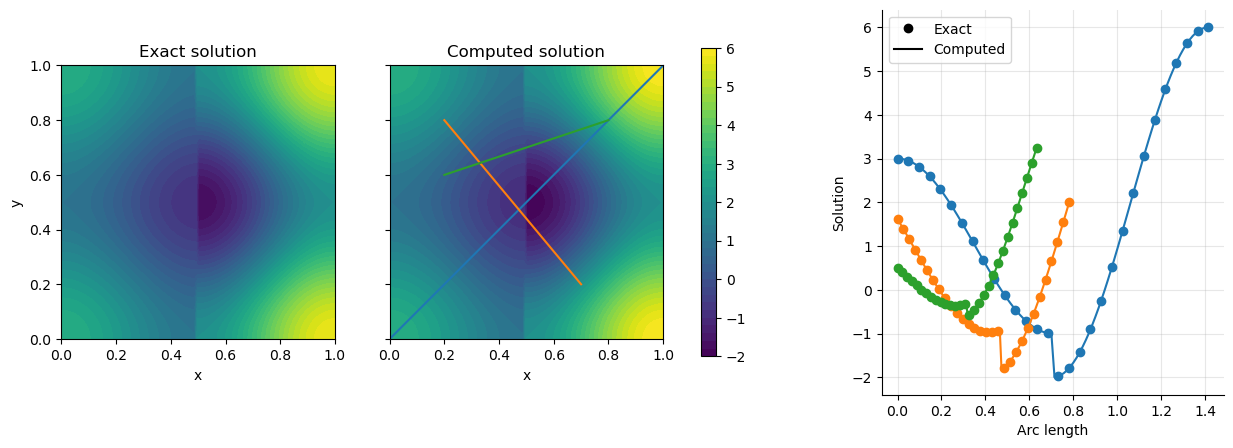
The computed and exact solutions agree very well:
Show code cell source
# export exact solution

u = f.Function(my_model.V_DG1)
v = f.TestFunction(my_model.V_DG1)
exact_solution_left = f.Expression(sp.printing.ccode(exact_solution_left), degree=2)
exact_solution_right = f.Expression(sp.printing.ccode(exact_solution_right), degree=2)
form = (
    u * v * my_model.mesh.dx
    - exact_solution_left * v * my_model.mesh.dx(1)
    - exact_solution_right * v * my_model.mesh.dx(2)
)

f.solve(form == 0, u, bcs=[])

computed_solution = my_model.h_transport_problem.mobile.post_processing_solution
E = f.errornorm(computed_solution, u, "L2")
print(f"L2 error: {E:.2e}")

# plot exact solution and computed solution
fig, axs = plt.subplots(1, 3, figsize=(15, 5))
plt.sca(axs[0])
plt.title("Exact solution")
plt.xlabel("x")
plt.ylabel("y")
CS1 = f.plot(u)
plt.sca(axs[1])
plt.xlabel("x")
plt.title("Computed solution")
CS2 = f.plot(computed_solution)

for CS in [CS1, CS2]:
    CS.set_edgecolor("face")

plt.colorbar(CS2, ax=[axs[0], axs[1]], shrink=0.8)

axs[0].sharey(axs[1])
plt.setp(axs[1].get_yticklabels(), visible=False)


def compute_arc_length(xs, ys):
    """Computes the arc length of x,y points based
    on x and y arrays
    """
    points = np.vstack((xs, ys)).T
    distance = np.linalg.norm(points[1:] - points[:-1], axis=1)
    arc_length = np.insert(np.cumsum(distance), 0, [0.0])
    return arc_length


# define the profiles
profiles = [
    {"start": (0.0, 0.0), "end": (1.0, 1.0)},
    {"start": (0.2, 0.8), "end": (0.7, 0.2)},
    {"start": (0.2, 0.6), "end": (0.8, 0.8)},
]

# plot the profiles on the right subplot
for i, profile in enumerate(profiles):
    start_x, start_y = profile["start"]
    end_x, end_y = profile["end"]
    plt.sca(axs[1])
    (l,) = plt.plot([start_x, end_x], [start_y, end_y])

    plt.sca(axs[2])

    points_x_exact = np.linspace(start_x, end_x, num=30)
    points_y_exact = np.linspace(start_y, end_y, num=30)
    arc_length_exact = compute_arc_length(points_x_exact, points_y_exact)
    u_values = [u(x, y) for x, y in zip(points_x_exact, points_y_exact)]

    points_x = np.linspace(start_x, end_x, num=100)
    points_y = np.linspace(start_y, end_y, num=100)
    arc_lengths = compute_arc_length(points_x, points_y)
    computed_values = [computed_solution(x, y) for x, y in zip(points_x, points_y)]

    (exact_line,) = plt.plot(
        arc_length_exact, u_values, color=l.get_color(), marker="o", linestyle="None"
    )
    (computed_line,) = plt.plot(arc_lengths, computed_values, color=l.get_color())

plt.sca(axs[-1])
plt.xlabel("Arc length")
plt.ylabel("Solution")

legend_marker = mpl.lines.Line2D(
    [],
    [],
    color="black",
    marker=exact_line.get_marker(),
    linestyle="None",
    label="Exact",
)

legend_line = mpl.lines.Line2D([], [], color="black", label="Computed")
plt.legend(
    [legend_marker, legend_line], [legend_marker.get_label(), legend_line.get_label()]
)

plt.grid(alpha=0.3)
plt.gca().spines[["right", "top"]].set_visible(False)
plt.show()
Calling FFC just-in-time (JIT) compiler, this may take some time.
Calling FFC just-in-time (JIT) compiler, this may take some time.
Calling FFC just-in-time (JIT) compiler, this may take some time.
Calling FFC just-in-time (JIT) compiler, this may take some time.
Calling FFC just-in-time (JIT) compiler, this may take some time.
Calling FFC just-in-time (JIT) compiler, this may take some time.
L2 error: 5.49e-04