Diffusion multi-material#

🏷 Tags: 2D MMS Multi-material steady state

The first MMS problem has two materials (denoted, respectively, by left and right). In material left, the solubility is \(K_{S,\mathrm{left}} = 3\) and the diffusivity is \(D_\mathrm{left} = 2\). In material right, the solubility is \(K_{S,\mathrm{right}} = 6\) and the diffusivity is \(D_\mathrm{right} = 5\). Two exact solutions for mobile concentration of hydrogen are manufactured for both subdomains:

(16)#\[\begin{align} c_\mathrm{left,exact} &= 1 + \sin{\left(\pi \left(2 x + 0.5\right) \right)} + \cos{\left(2 \pi y \right)} \\ c_\mathrm{right,exact} &= \dfrac{K_{S,\mathrm{right}}}{K_{S,\mathrm{left}}} \ c_\mathrm{left,exact} \end{align}\]

MMS sources are derived in each material:

(17)#\[\begin{align} S_\mathrm{left} &= 8 \pi^{2} \left(\cos{\left(2 \pi x \right)} + \cos{\left(2 \pi y \right)}\right) \\ S_\mathrm{right} &= 40 \pi^{2} \left(\cos{\left(2 \pi x \right)} + \cos{\left(2 \pi y \right)}\right) \end{align}\]

These exact solutions can then determine the MMS fluxes and boundary conditions.

FESTIM code#

Hide code cell source

import festim as F
import numpy as np
import dolfinx
import ufl
from mpi4py import MPI

# Create and mark the mesh
nx = ny = 10
fenics_mesh = dolfinx.mesh.create_unit_square(MPI.COMM_WORLD, nx, ny)


class LeftSurface(F.SurfaceSubdomain):
    def locate_boundary_facet_indices(self, mesh):
        return dolfinx.mesh.locate_entities_boundary(
            mesh, mesh.topology.dim - 1, lambda x: np.isclose(x[0], 0.0)
        )


class RightSurface(F.SurfaceSubdomain):
    def locate_boundary_facet_indices(self, mesh):
        return dolfinx.mesh.locate_entities_boundary(
            mesh, mesh.topology.dim - 1, lambda x: np.isclose(x[0], 1.0)
        )


class TopRightSurface(F.SurfaceSubdomain):
    def locate_boundary_facet_indices(self, mesh):
        return dolfinx.mesh.locate_entities_boundary(
            mesh, mesh.topology.dim - 1, lambda x: np.isclose(x[1], 1.0) & (x[0] > 0.5)
        )


class TopLeftSurface(F.SurfaceSubdomain):
    def locate_boundary_facet_indices(self, mesh):
        return dolfinx.mesh.locate_entities_boundary(
            mesh, mesh.topology.dim - 1, lambda x: np.isclose(x[1], 1.0) & (x[0] < 0.5)
        )


class BottomRightSurface(F.SurfaceSubdomain):
    def locate_boundary_facet_indices(self, mesh):
        return dolfinx.mesh.locate_entities_boundary(
            mesh, mesh.topology.dim - 1, lambda x: np.isclose(x[1], 0.0) & (x[0] > 0.5)
        )


class BottomLeftSurface(F.SurfaceSubdomain):
    def locate_boundary_facet_indices(self, mesh):
        return dolfinx.mesh.locate_entities_boundary(
            mesh, mesh.topology.dim - 1, lambda x: np.isclose(x[1], 0.0) & (x[0] < 0.5)
        )


class LeftSubdomain(F.VolumeSubdomain):
    def locate_subdomain_entities(self, mesh):
        return dolfinx.mesh.locate_entities(
            mesh, mesh.topology.dim, lambda x: x[0] < 0.5 + 1e-10
        )


class RightSubdomain(F.VolumeSubdomain):
    def locate_subdomain_entities(self, mesh):
        return dolfinx.mesh.locate_entities(
            mesh, mesh.topology.dim, lambda x: x[0] >= 0.5 - 1e-10
        )


left_surface = LeftSurface(id=1)
right_surface = RightSurface(id=2)
top_left_surface = TopLeftSurface(id=3)
bottom_left_surface = BottomLeftSurface(id=4)
top_right_surface = TopRightSurface(id=5)
bottom_right_surface = BottomRightSurface(id=6)


# Create the FESTIM model
my_model = F.HydrogenTransportProblemDiscontinuous()

my_model.mesh = F.Mesh(fenics_mesh)

D_left, D_right = 2, 5  # diffusion coeffs
S_left = 3
S_right = 6

mat_left = F.Material(D_0=D_left, E_D=0, K_S_0=S_left, E_K_S=0)
mat_right = F.Material(D_0=D_right, E_D=0, K_S_0=S_right, E_K_S=0)
left_volume = LeftSubdomain(id=1, material=mat_left)
right_volume = RightSubdomain(id=2, material=mat_right)

my_model.subdomains = [
    left_volume,
    right_volume,
    left_surface,
    right_surface,
    top_left_surface,
    bottom_left_surface,
    top_right_surface,
    bottom_right_surface,
]

my_model.surface_to_volume = {
    left_surface: left_volume,
    right_surface: right_volume,
    top_left_surface: left_volume,
    bottom_left_surface: left_volume,
    top_right_surface: right_volume,
    bottom_right_surface: right_volume,
}

my_model.interfaces = [F.Interface(id=7, subdomains=[left_volume, right_volume])]

H = F.Species("H", subdomains=my_model.volume_subdomains)
my_model.species = [H]


def exact_solution_left(mod):
    return lambda x: (
        1 + mod.sin(2 * mod.pi * (x[0] + 0.25)) + mod.cos(2 * mod.pi * x[1])
    )


def exact_solution_right(mod):
    return lambda x: S_right / S_left * exact_solution_left(mod)(x)


exact_solution_left_ufl = exact_solution_left(ufl)
exact_solution_right_ufl = exact_solution_right(ufl)


# source terms
f_left = lambda x: -ufl.div(D_left * ufl.grad(exact_solution_left_ufl(x)))
f_right = lambda x: -ufl.div(D_right * ufl.grad(exact_solution_right_ufl(x)))


my_model.sources = [
    F.ParticleSource(f_left, volume=left_volume, species=H),
    F.ParticleSource(f_right, volume=right_volume, species=H),
]

# boundary conditions
my_model.boundary_conditions = [
    F.FixedConcentrationBC(subdomain=surface, value=exact_solution_left_ufl, species=H)
    for surface in [left_surface, top_left_surface, bottom_left_surface]
] + [
    F.FixedConcentrationBC(subdomain=surface, value=exact_solution_right_ufl, species=H)
    for surface in [right_surface, top_right_surface, bottom_right_surface]
]


my_model.temperature = 500.0

my_model.settings = F.Settings(atol=1e-10, rtol=1e-10, transient=False)

my_model.initialise()
my_model.run()

Hide code cell output

/home/docs/checkouts/readthedocs.org/user_builds/festim-vv-report/conda/festim-2/lib/python3.11/site-packages/festim/coupled_heat_hydrogen_problem.py:1: TqdmExperimentalWarning: Using `tqdm.autonotebook.tqdm` in notebook mode. Use `tqdm.tqdm` instead to force console mode (e.g. in jupyter console)
  import tqdm.autonotebook

Comparison with exact solution#

The concentration fields can be visualised using pyvista.

import pyvista
from dolfinx.plot import vtk_mesh

pyvista.start_xvfb()
pyvista.set_jupyter_backend("html")


def get_ugrid(computed_solution: dolfinx.fem.Function, label):
    u_topology, u_cell_types, u_geometry = vtk_mesh(computed_solution.function_space)
    u_grid = pyvista.UnstructuredGrid(u_topology, u_cell_types, u_geometry)
    u_grid.point_data[label] = computed_solution.x.array.real
    u_grid.set_active_scalars(label)
    return u_grid


u_plotter = pyvista.Plotter(shape=(1, 2))
u_grid_left = get_ugrid(H.subdomain_to_post_processing_solution[left_volume], "c")
u_grid_right = get_ugrid(H.subdomain_to_post_processing_solution[right_volume], "c")

u_plotter.subplot(0, 0)
u_plotter.add_mesh(u_grid_left, show_edges=True)
u_plotter.add_mesh(u_grid_right, show_edges=True)
u_plotter.view_xy()

u_plotter.subplot(0, 1)
exact_left = dolfinx.fem.Function(
    H.subdomain_to_post_processing_solution[left_volume].function_space
)
exact_left.interpolate(exact_solution_left(np))
exact_right = dolfinx.fem.Function(
    H.subdomain_to_post_processing_solution[right_volume].function_space
)
exact_right.interpolate(exact_solution_right(np))
u_grid_exact_left = get_ugrid(exact_left, "c_exact")
u_grid_exact_right = get_ugrid(exact_right, "c_exact")


u_plotter.add_mesh(u_grid_exact_left, show_edges=False)
u_plotter.add_mesh(u_grid_exact_right, show_edges=False)
u_plotter.view_xy()

if not pyvista.OFF_SCREEN:
    u_plotter.show()
else:
    figure = u_plotter.screenshot("discontinuity_concentration.png")
/home/docs/checkouts/readthedocs.org/user_builds/festim-vv-report/conda/festim-2/lib/python3.11/site-packages/pyvista/plotting/utilities/xvfb.py:48: PyVistaDeprecationWarning: This function is deprecated and will be removed in future version of PyVista. Use vtk-osmesa instead.
  warnings.warn(

Computing errors#

First, we compute the \(L^2\)-norm of the error, defined by \(E=\sqrt{\int_\Omega (c-c_\mathrm{exact})^2\mathrm{d} x}\). Secondly, we compute the maximum error at any degree of freedom.

Hide code cell source

def error_L2(u_computed, u_exact, degree_raise=3):
    # Create higher order function space
    degree = u_computed.function_space.ufl_element().degree
    family = u_computed.function_space.ufl_element().family_name
    mesh = u_computed.function_space.mesh
    W = dolfinx.fem.functionspace(mesh, (family, degree + degree_raise))

    # Interpolate exact solution, special handling if exact solution
    # is a ufl expression or a python lambda function
    u_ex_W = dolfinx.fem.Function(W)
    if isinstance(u_exact, ufl.core.expr.Expr):
        u_expr = dolfinx.fem.Expression(u_exact, W.element.interpolation_points)
        u_ex_W.interpolate(u_expr)
    else:
        u_ex_W.interpolate(u_exact)

    # Integrate the error
    error = dolfinx.fem.form(
        ufl.inner(u_computed - u_ex_W, u_computed - u_ex_W) * ufl.dx
    )
    error_local = dolfinx.fem.assemble_scalar(error)
    error_global = mesh.comm.allreduce(error_local, op=MPI.SUM)
    return np.sqrt(error_global)
computed_left = H.subdomain_to_post_processing_solution[left_volume]
computed_right = H.subdomain_to_post_processing_solution[right_volume]

E_l2_left = error_L2(computed_left, exact_solution_left(np))
E_max_left = np.max(np.abs(exact_left.x.array - computed_left.x.array))
E_l2_right = error_L2(computed_right, exact_solution_right(np))
E_max_right = np.max(np.abs(exact_right.x.array - computed_right.x.array))

print("Left volume:")
print(f"L2 error: {E_l2_left:.2e}")
print(f"Max error: {E_max_left:.2e}")

print("\nRight volume:")
print(f"L2 error: {E_l2_right:.2e}")
print(f"Max error: {E_max_right:.2e}")
Left volume:
L2 error: 2.78e-02
Max error: 5.63e-02

Right volume:
L2 error: 5.26e-02
Max error: 7.25e-02

Compute convergence rates#

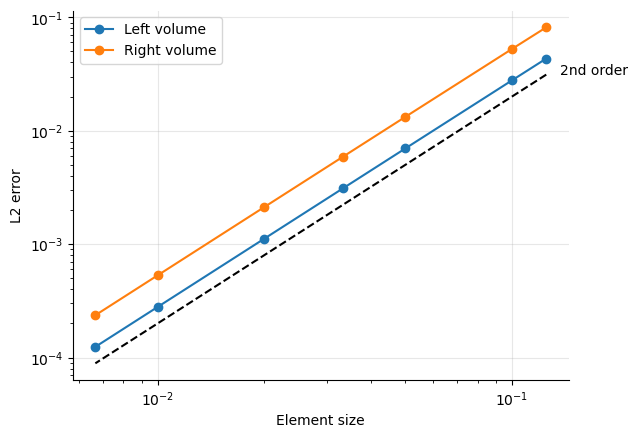
It is also possible to compute how the numerical error decreases as we increase the number of cells. By iteratively refining the mesh, we find that the error exhibits a second order convergence rate. This is expected for this particular problem as first order finite elements are used.

import matplotlib.pyplot as plt

errors_left, errors_right = [], []
ns = [8, 10, 20, 30, 50, 100, 150]

for n in ns:
    nx = ny = n
    fenics_mesh = dolfinx.mesh.create_unit_square(MPI.COMM_WORLD, nx, ny)

    new_model = F.HydrogenTransportProblemDiscontinuous()
    new_model.mesh = F.Mesh(fenics_mesh)

    new_model.species = my_model.species
    new_model.subdomains = my_model.subdomains
    new_model.surface_to_volume = my_model.surface_to_volume
    new_model.interfaces = my_model.interfaces
    new_model.sources = my_model.sources
    new_model.boundary_conditions = my_model.boundary_conditions
    new_model.temperature = my_model.temperature
    new_model.settings = my_model.settings


    new_model.initialise()
    new_model.run()

    computed_solution_left = H.subdomain_to_post_processing_solution[left_volume]
    computed_solution_right = H.subdomain_to_post_processing_solution[right_volume]
    errors_left.append(error_L2(computed_solution_left, exact_solution_left(np)))
    errors_right.append(error_L2(computed_solution_right, exact_solution_right(np)))

h = 1 / np.array(ns)

plt.loglog(h, errors_left, marker="o", label="Left volume")
plt.loglog(h, errors_right, marker="o", label="Right volume")
plt.xlabel("Element size")
plt.ylabel("L2 error")

plt.loglog(h, 2 * h**2, linestyle="--", color="black")
plt.annotate(
    "2nd order", (h[0], 2 * h[0] ** 2), textcoords="offset points", xytext=(10, 0)
)

plt.grid(alpha=0.3)
plt.gca().spines[["right", "top"]].set_visible(False)
plt.legend()
plt.show()
../../_images/05f687ef58d1c48dee2c63a130d79815213a1baa499fc10b1f0aa1b07b85ac4b.png